Brackish Water: Where Fresh Meets Salt | Guide
Brackish Zones: Where Water Can’t Decide What It Is and Physics Gets Weird
Water has an identity crisis in estuaries, and it’s causing absolute chaos at the molecular level.
You know how oil and vinegar don’t mix in salad dressing? Freshwater and saltwater have the same energy, except they’re both technically water, so they CAN’T just separate cleanly.
Instead, they create this deeply uncomfortable middle zone where physics loses its mind.
Welcome to brackish water , the awkward teenager phase of H2O.
So what’s actually going on down there?
Saltwater is hefty. Like, substantially heavier than freshwater. We’re talking a 2.5% density difference, which sounds tiny. But this is enough to make freshwater float on top of saltwater.
Saltwater weighs about 1.025 grams for every cubic centimeter. Freshwater is only 1.0. This small difference lets something called a “salt wedge” happen. The ocean water sneaks along the bottom of the river, while the river water moves fast along the top.
If you’re imagining how estuaries (where rivers meet the sea) look, think - cool drinks with different layers. The layers try to mix, but they don’t do a good job.
The Invisible Jell-O Wall
In between the light water and heavy water, there’s this zone called a halocline.
Literally called “salt cliffs,” where salinity can jump from 5 parts per thousand to 30 ppt in just ~10ft of depth.
Scuba divers HATE these things.
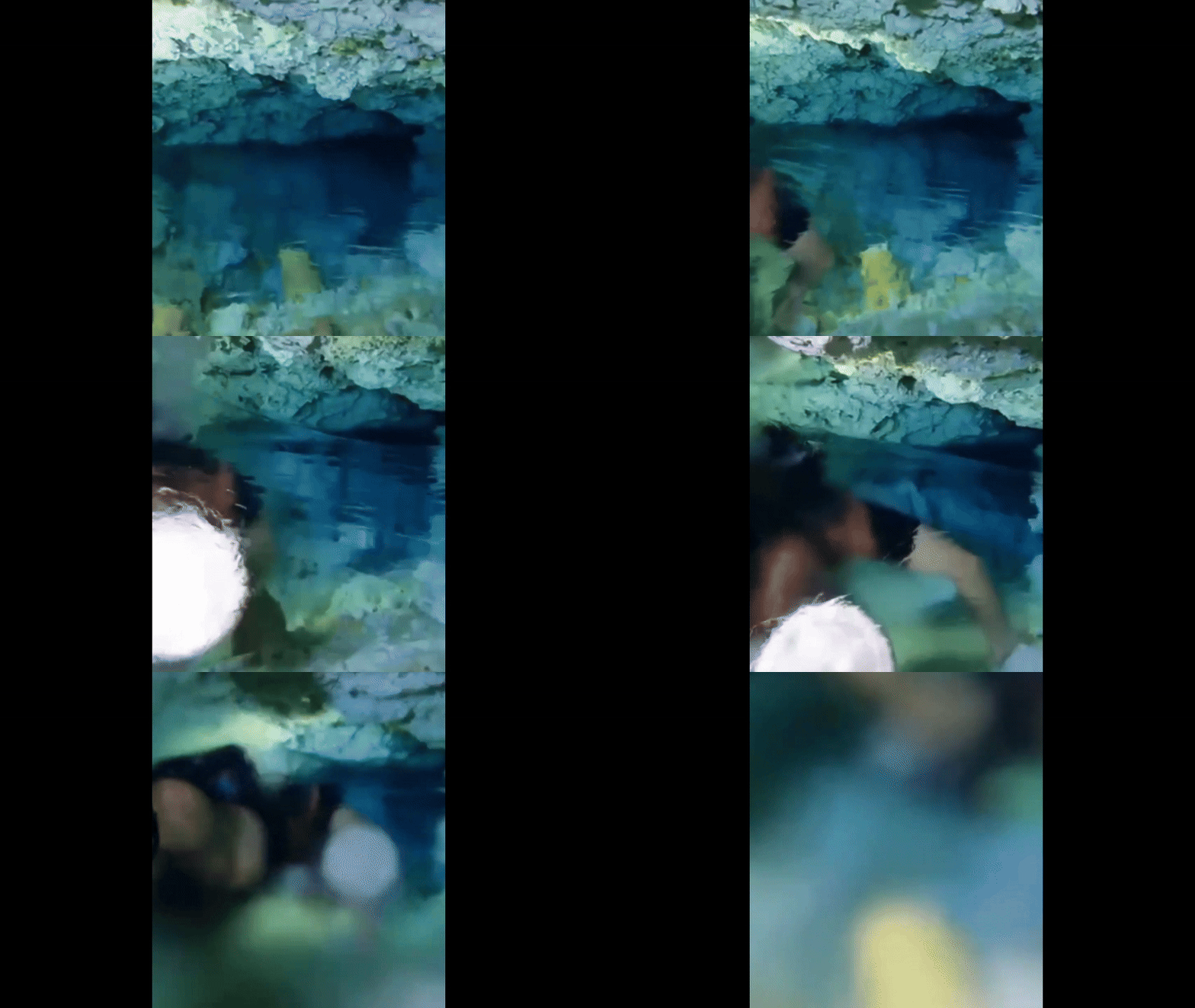
Scubadivers in a Halocline Zone. Video Credit - YouTube handle SergioSesini974
You’re swimming along, everything’s fine, and then BAM, you hit this invisible wall that feels like slightly thick air. Except you’re underwater, so that makes no sense.
Your body gets more floaty or less floaty out of nowhere. Your brain gets confused. And you can SEE it shimmer like heat waves on a road.
That shimmer? Light bending through different water thicknesses. You’re literally swimming through a mirage.
Photographers LOVE haloclines because you can get these shots where half the image is crystal clear and the other half looks like someone smeared Vaseline on the lens. It’s all the same water. Just different salt content.
Submarines Playing Hide and Seek
Okay, this part will blow your mind.
Sound travels faster through thick salty water than through thin fresh water. Not by much, like 134 miles per hr difference, but that’s enough to completely break sonar.
When Navy submarines send out sonar pings, the sound waves hit these haloclines and just… bounce. Like throwing a tennis ball at a trampoline. The sound never reaches the submarine hiding below.
During the Cold War, Russian subs would literally park inside haloclines in the Baltic Sea (which is super brackish) and become invisible. American destroyers would be up top going “WHERE IS IT” while the Russians were chilling in the salt layer, eating borscht or whatever.
Now the Navy has fancy sensors that cost $50,000 each just to find where the salty layers are. They’re playing a $50K game of “where’s the invisible Jell-O.”
Water Grows Fingers and It’s Weird
This is where things get seriously weird.
Sometimes hot salty water floats on top of cold fresh water. Normally, hot water should rise, right? But salt makes it heavier. So physics just gives up.
What happens next? The water grows fingers.
I’m not kidding, thin columns of salty water sink while fresh water rises, twisting together like ghostly, see-through fingers. Each is about an inch wide but several feet long, waving gently like something alive.
Scientists use special cameras and dyes to film them, and it looks like some alien organ pulsing under the sea.
These strange fingers help mix nutrients that feed plankton, fish, and everything up the food chain.
So yeah, creepy water fingers basically run the ocean.
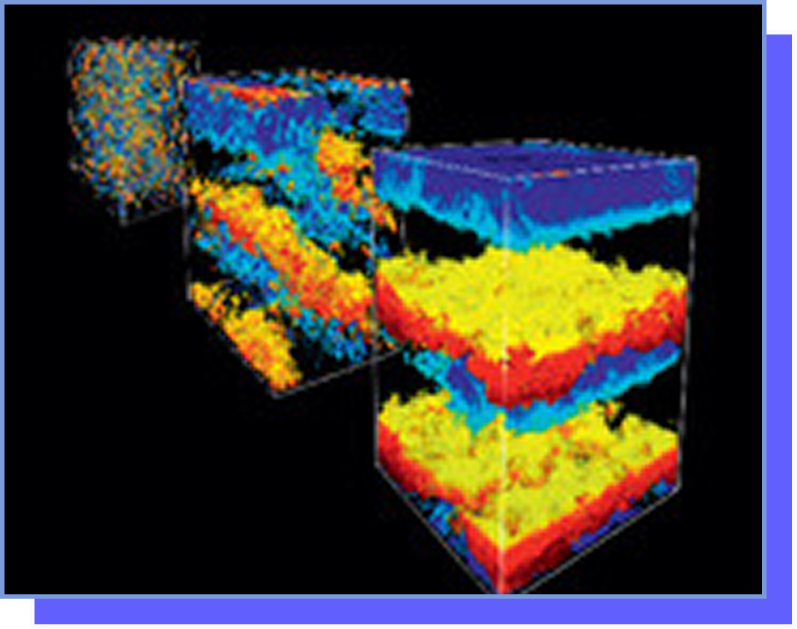
Double Diffusive Convection. Pic Credit - Timour Radko, Cambridge University Press.
The Slushie Zone
In some cold brackish areas, the water gets colder than freezing but doesn’t actually freeze. The salt messes with the ice crystals forming. So you get this supercooled water just vibing below 32°F.
Touch it? Instant ice. The whole thing crystallizes immediately like those supercooled water bottle videos on TikTok.
This happens naturally in Norwegian fjords. Just patches of water waiting to become ice the second something disturbs them.
Scientists are studying this to figure out how to freeze human organs without the ice crystals shredding everything. Because apparently, brackish water knows secrets about cryogenics that we don’t.
The Water Makes Electricity
The salt difference creates a voltage like an actual battery.
It’s tiny, like 10 to 50 millivolts, but it’s there. Sharks can sense it. Horseshoe crabs can sense it with their BUTTS (they have light sensors on their tails, don’t ask).
Some animals literally navigate by reading the electrical signature of brackish water. It’s their GPS.
Engineers want to harvest this. Stick electrodes in the halocline, collect the voltage from ions moving around, boom, free electricity from salty water just existing. They call it “blue energy.”
Norway tested a pilot plant from 2009 to 2014, but shut it down because the costs of the membrane were too high.
The math says you could get 185.8 Watts per square foot. That’s enough to power a house just from one sheet of special membrane in a halocline.
Imagine telling someone in 1823 that we’d power cities with invisible salt walls. They’d have you committed.
Climate Change is Moving the Salt
Rising sea levels mean saltwater is pushing further up rivers. Louisiana’s salt zone has been moving one inch inland every year since 1950.
Freshwater fish that have never seen salt in their entire evolutionary history? They’re seeing it now. And they’re dying.
Meanwhile, droughts are making some brackish zones TOO salty. San Francisco Bay nearly reached full ocean salinity during the 2021 drought. Everything adapted to medium-salt water just… couldn’t handle it.
The climate is rearranging where the weird water physics happens. And nobody really knows what that’s gonna do long-term.
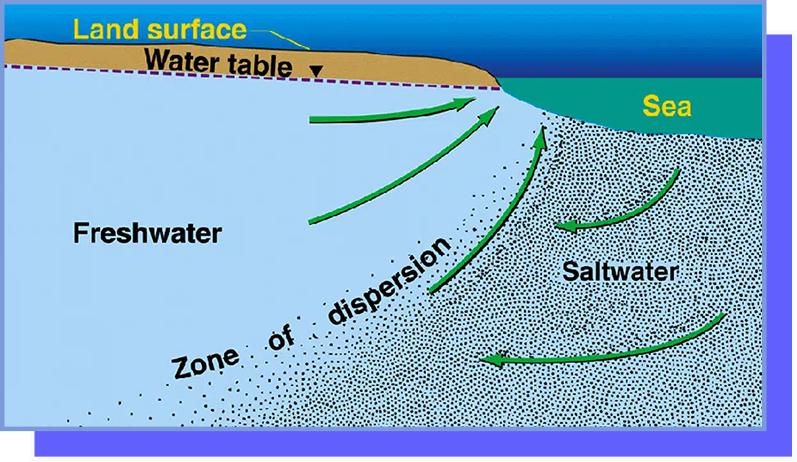
Graphic of Coastal Seawater Intrusion. Pic Credit - California Water Science Center.
The Point
Brackish water is a whole physics nightmare with invisible walls, sound-bending layers, creepy fingers, electricity, and identity issues.
It’s water that can’t commit to being fresh OR salty, so it just does weird science experiments instead.
You are unbelievable, MAMA NATURE!!
What Exactly IS Brackish Water? (Let’s Get Technical for a Sec)
Okay, so we’ve covered the weird stuff. But what actually defines brackish water in terms of salinity range?
Brackish water salinity sits between 0.5 and 30 parts per thousand (ppt), or 500 to 30,000 parts per million (ppm) if you’re feeling fancy.
To put that in perspective:
-
Freshwater : Less than 0.5 ppt (basically zero salt)
-
Brackish water : 0.5 to 30 ppt (the awkward middle)
-
Seawater : 33 to 38 ppt (full ocean vibes)
So when you’re sipping your morning coffee with one sugar cube, that’s about 10 ppt. Brackish water at the lower end is like weak tea. At the higher end? It’s getting spicy.
Famous Brackish Water Hotspots Around the World
Brackish water ecosystems exist everywhere rivers kiss the sea. Here are the VIPs of the brackish world:
1. Chesapeake Bay, USA
The largest estuary in North America. Home to blue crabs, striped bass, and more oysters than you can shake a shucking knife at. Salinity here swings wildly depending on season and rainfall, from near-fresh to almost full salt.
2. Thames Estuary, UK
Where London’s river meets the North Sea. Once so polluted you couldn’t find fish. Now? It’s a comeback story with over 115 fish species including flounder, sea bass, and even the occasional lost seal.
3. Baltic Sea, Northern Europe
The world’s largest inland brackish sea. It’s so weird that cod live in the deep salty layers while pike hang out in the fresher surface waters. It’s like an underwater apartment building with rich and poor neighborhoods.
4. San Francisco Bay, California
A tectonic estuary (formed by earthquakes, not glaciers). Salinity varies dramatically from the Sacramento-San Joaquin River Delta (almost fresh) to the Golden Gate (nearly full ocean).
5. Amazon River Estuary
So powerful that it pushes freshwater ~90 miles out into the Atlantic Ocean. The mixing zone is HUGE, you can be miles offshore and still find brackish water.
The Double-Diffusive Convection Mystery (AKA Why Water Grows Fingers)
Scientists call those creepy water fingers “double-diffusive convection ” or “salt fingers ,” and they’re one of the coolest phenomena in oceanography.
Here’s the science:
Heat diffuses through water about 100 times faster than salt. When warm, salty water sits on top of cool, fresh water, heat escapes quickly but salt stays put. This creates these thin, finger-like columns of descending salty water and rising fresh water.
Salt fingers are typically:
-
1 to 3 inches wide
-
Several feet long
-
Move at speeds of a few millimeters per second
They’re like nature’s tiny conveyor belts, mixing the ocean vertically. Without them, ocean stratification would be way more stable, and nutrient distribution would be completely different.
Scientists discovered these in the 1960s, and they’re still trying to figure out exactly how much they affect global ocean circulation and climate. Plot twist: they might be more important than we thought.
Salt Wedge Estuaries: The Mississippi’s Superpower
The Mississippi River is the poster child for salt wedge estuaries.
During high river flow, freshwater barrels downstream so fast that saltwater can barely sneak in. The salt water forms a thin wedge along the bottom, with a sharp boundary separating it from fresh water above.
But here’s the kicker: In the drought of 1939-1940, saltwater intruded 140 miles (225 kilometers**) upstream** , the farthest salt intrusion ever recorded anywhere in the world.
Now the U.S. Army Corps of Engineers builds underwater barriers in the river channel to stop the salt wedge from creeping too far inland and contaminating drinking water supplies for New Orleans.
Other famous salt wedge estuaries:
-
Columbia River (Washington/Oregon)
-
Hudson River (New York)
-
Fraser River (Canada)
These estuaries are highly stratified , meaning the layers don’t mix much. It’s like oil and vinegar, but both are water.
Brackish Water Fish Species: The Salt-Tolerant Squad
Not all fish can handle the salinity swings of brackish water. But the ones that can? They’re built different.
Bull Sharks
These absolute units can survive in fresh, brackish, AND saltwater. They’ve been spotted in the Mississippi River, the Amazon, and even Lake Nicaragua. Their kidneys can adjust salt excretion on the fly, like having a built-in desalination plant.
1. Mudskippers
Fish that walk on land. No, seriously. They use their pectoral fins like legs and can breathe air for hours. Found in mangrove swamps across Africa and Asia, they’re the amphibians of the fish world.
2. Striped Bass
These guys migrate between salt and fresh water to spawn. They’re anadromous , meaning they’re born in fresh water, live in the ocean, and return to fresh water to breed.
3. Mullet
The unsung heroes of brackish ecosystems. They eat algae and detritus, basically cleaning up the water. Aquaculture farmers love them because they’re hardy and grow fast in low-salinity ponds.
4. Oysters
These filter feeders can handle salinity from 5 to 35 ppt. They filter 25-50 gallons of water per day, removing pollutants and excess nutrients. Oysters in brackish water tend to be sweeter than ocean oysters because they’re filtering less salt.
5. Archer Fish
The snipers of the fish world. They shoot jets of water at insects above the water’s surface, knocking them down to eat them. Found in Southeast Asian brackish mangroves.
Brackish Water Aquaculture: Farming the In-Between
Brackish water aquaculture is a multi-billion-dollar industry, especially in Asia.
1. Shrimp Farming
The star of the show. Species like Penaeus monodon (black tiger shrimp) and Litopenaeus vannamei (Pacific white shrimp) are farmed in brackish ponds across Thailand, India, Ecuador, and Bangladesh.
Fun fact: Shrimp farming is so lucrative that in some regions, farmers have converted rice paddies into shrimp ponds. It’s called “shrimp-rice rotation ”, grow rice during the monsoon, farm shrimp during the dry season.
2. Milkfish
A major food fish in Southeast Asia. Grows fast in brackish ponds and can tolerate salinity from 0 to 30 ppt.
3. Tilapia
While usually a freshwater fish, some species like the orange chromide thrive in brackish conditions.
4. Prawn Farming
The giant river prawn (Macrobrachium rosenbergii) needs brackish water during its larval stage but grows to market size in fresh water. Hatcheries create artificial brackish conditions (9-19 ppt) to raise larvae before transferring them to freshwater growout ponds.
Blue Energy: Harvesting Power from Salt Gradients
This is where it gets WILD.
Osmotic power (also called salinity gradient energy) extracts energy from the difference in salt concentration between fresh and salt water.
How It Works: Pressure Retarded Osmosis (PRO)
-
Place fresh water and salt water on opposite sides of a special membrane
-
Freshwater molecules naturally flow toward the saltwater side (osmosis)
-
This creates pressure
-
Use that pressure to spin a turbine
-
Boom, electricity
The Norway Experiment
In 2009, Norwegian energy company Statkraft opened the world’s first osmotic power plant in Tofte, Norway.
The results?
-
Initial output: 4 kilowatts (enough to boil a kettle)
-
Target: 25 megawatts by 2015
-
Reality: Shut down in 2014 because membrane costs were too high
The potential, though?
-
Global capacity: 1.4 to 2.6 terawatts
-
That’s enough to power Eastern Europe and Russia combined
-
Each cubic meter of freshwater mixing with seawater releases 0.8 kWh of energy
New players are emerging. Sweetch Energy in France is testing next-gen membranes that could finally make this economically viable.
Can You Drink Brackish Water? (Spoiler: Not Without Help)
Short answer: No.
Longer answer: Hell no.
Drinking untreated brackish water will dehydrate you faster than drinking nothing at all. Here’s why:
Your kidneys need to produce urine to flush out excess salt. To make that urine, your body pulls water from your cells. Net result? You lose more water than you gained.
Symptoms of drinking brackish water:
-
Extreme thirst (ironically)
-
Nausea and vomiting
-
Dizziness
-
Dehydration
-
Kidney damage (long-term)
But Wait, We Can Fix It
Brackish water desalination is way easier than desalinating seawater because there’s less salt to remove.
Methods:
-
Reverse Osmosis (RO) : Push water through a membrane that blocks salt but lets water through. Can remove 99.9% of dissolved salts.
-
Distillation : Boil the water, collect the steam, leave the salt behind.
-
Electrodialysis : Use an electric field to separate salt ions from water.
Once treated, brackish water is perfectly safe to drink—and millions of people rely on it.
Places using brackish water for drinking:
-
Texas and the southwestern U.S. (groundwater aquifers)
-
Israel (largest desalination infrastructure in the world)
-
Middle Eastern countries (UAE, Saudi Arabia, Kuwait)
-
Small island nations (Singapore, Maldives)
Brackish Water Desalination: Cheaper Than Seawater, But Still Not Free
Desalinating brackish water uses less energy than seawater because the salinity is lower.
Energy comparison:
-
Seawater desalination: ~3-4 kWh per cubic meter
-
Brackish water desalination: ~0.5-2 kWh per cubic meter
Cost comparison:
-
Seawater desalination: $1.50-$2.00 per cubic meter
-
Brackish water desalination: $0.50-$1.00 per cubic meter
Still, it’s expensive enough that it’s mainly used in water-scarce regions where there’s no other choice.
Thermohaline Circulation: The Planetary Conveyor Belt
Brackish zones play a sneaky role in the thermohaline circulation —the global ocean current system driven by temperature and salinity differences.
Fresh water from rivers reduces salinity at the surface, which affects water density. Less dense water floats, more dense water sinks. This density-driven sinking and rising drives ocean currents that circulate nutrients, oxygen, and heat around the planet.
If climate change dumps too much freshwater into the ocean (from melting ice sheets), it could slow down or even stop this circulation. That would be very, very bad for global climate stability.
Inverse Estuaries: The Bizarro Brackish Zones
Most estuaries get saltier as you move toward the ocean. But inverse estuaries do the opposite, they get SALTIER as you move inland.
How? Extreme evaporation.
In hot, dry climates like the Persian Gulf and Australia’s Spencer Gulf, evaporation exceeds freshwater input. So seawater flows in, evaporates, and leaves salt behind. The water at the head of the estuary can be saltier than the ocean.
Water World Roundup
A project that turns wastewater into green methanol
Pic Credit - Aqua Tech Trade.
Antarctic robot ‘Lassie’ finds thousands of icefish under the Antarctic ice
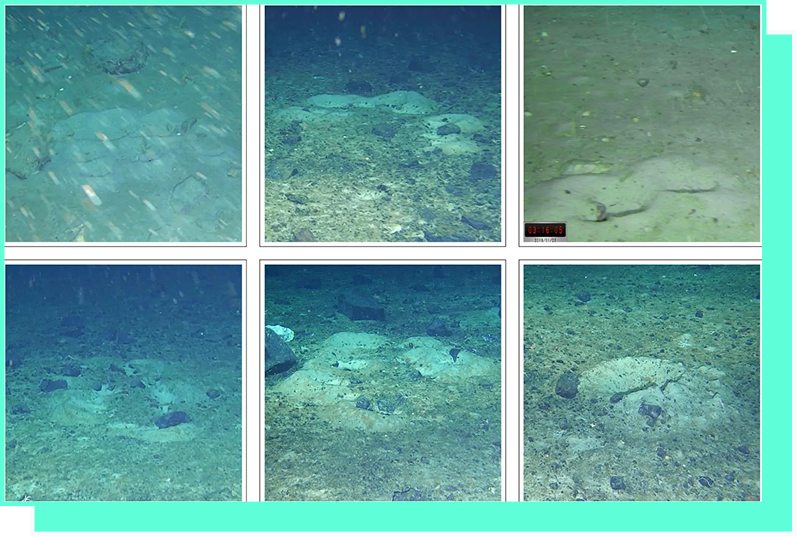
Pic Credit - Weddell Sea Expedition 2019
Can Ozone Make Water Treatment More Resilient?
pic credit - wikipedia
Water Meme Of The Month

Meme Credit - Meme_Hoarder